
The Moss landing power plant is one of the largest power generation facilities in the entire United States of America west coast. It is situated in Moss landing, California and over the last ten years has significantly changed with the dynamics of the market, technological advancement, and the energy policies in California.
It has it all in the article, including its history and impact on the environment, as well as its existing purpose in energy storage, generation capacity, technical implication, cost, and future perspectives. The content should be educational, informative, and traffic-generating to the readers who may be interested in energy technology, a massive power structure, renewable integration, and power infrastructure investment.
What is the Moss landing power plant?
Moss landing power plant is a large storage and power plant located on the Monterey Bay in California, between Monterey and Santa Cruz some half way down the bay. It was originally planned to be powered by natural gas-fired power station but it has evolved to be one of the biggest battery energy storage station in the world.
The plant also is critical in the grid reliability of California as it balances intermittent renewables like wind and solar and provides voltage support, reserve capacity and ancillary services.
Historical Timeline
| Year | Event |
| 1950s | Site selected due to proximity to transmission lines and cooling water from Monterey Bay. |
| 1950s–2000s | Multiple gas-fired turbines commissioned. |
| 2010s | Older units retired amid environmental regulations and economics. |
| 2020 | Battery storage conversion begins. |
| 2021–2023 | Moss Landing BESS brought online in staged capacity increments. |
| 2025 | Continued expansion and grid service refinements. |
Moss Landing Power Plant Budget Breakdown (CAPEX & Financial Overview)
It would be crucial to have an idea of the budget composition of the Moss Landing Power Plant to assess its financial feasibility, profitability, and sustainability in the long run. The plant has switched to one of the biggest battery energy storage systems (BESS) on earth instead of the standard gas-fired power plant. This change involved a lot of capital investment in various stages.
The following table is a tabular account of financial allocation of capital expenditure (CAPEX), infrastructural investment, safety enhancements and costs of incidents.
Total Project Budget Overview
The overall cost of the redevelop of Moss Landing battery storage is estimated to be between 800 and 1.2 billion depending on the expansion of the phases and the post-incident changes.
| Budget Category | Estimated Cost (USD) | Description |
| Phase I & II Development | ~$600 Million | Initial 300–750 MW battery installation |
| Phase III Expansion (CWIP) | ~$288 Million | Additional capacity expansion work |
| Battery Procurement | ~$586 Million | Lithium-ion battery modules & racks |
| Supporting Equipment & Systems | ~$176 Million | Inverters, transformers, wiring, enclosures |
| Land Acquisition | ~$18 Million | Coastal property acquisition cost |
| Thermal Management Systems | ~$27 Million | Cooling and ventilation infrastructure |
| Fire Suppression & Safety Upgrades | ~$14 Million | Post-incident fire prevention systems |
| Grid Interconnection & Upgrades | ~$9 Million | Transmission and CAISO integration |
| Environmental Compliance (Permits) | ~$6 Million | CEQA, environmental mitigation |
| Insurance Premium Adjustments (15 yrs) | ~$28 Million | Elevated BESS insurance costs |
| Depreciation Write-Off (Post Fire Incident) | ~$400 Million | Asset value impairment |
CAPEX Distribution by Percentage
To better understand spending allocation, here is an approximate breakdown of capital concentration:
| Category | % of Total Estimated Budget |
| Battery Systems | 55–60% |
| Infrastructure & Equipment | 15–20% |
| Expansion Phases | 10–15% |
| Safety & Thermal Systems | 5–7% |
| Compliance & Grid Integration | 3–5% |
| Insurance & Incident Loss | Variable impact |
Key Insight:
The cost driver that is dominant is battery modules as they consume over half of the total capital expenditure. This is in line with BESS cost structures worldwide as lithium-ion cells are costly as the most expensive elements.
Cost Per MW Analysis
With approximately 1,500 MW installed storage capacity, we can estimate:
| Metric | Value |
| Estimated Total Investment | ~$1 Billion (midpoint estimate) |
| Installed Capacity | 1,500 MW |
| Approximate Cost per MW | ~$666,000 per MW |
| Cost per MWh (6,000 MWh est.) | ~$166,000 per MWh |
These figures are consistent with utility-scale battery projects commissioned between 2020–2024 in California.
Current Facility Overview
Generating Units — Then and Now
The original plant operated a combination of steam turbines and gas turbines. However, most of the fossil fuel units have been retired due to:
- Air quality regulations
- Carbon reduction goals
- Market pressures from renewable energy
Today, the site combines battery energy storage, remaining generation capacity, and grid integration infrastructure.
Capacity Breakdown (2026)
| Facility Component | Type | Rated Capacity |
| Gas Turbine Generators | Thermal | ~575 MW (reduced) |
| Battery Energy Storage System (BESS) | Storage | ~1,500 MW / 6,000 MWh* |
| Total Installed | — | ~2,075 MW |
Transition to Battery Storage
The most important shift in Moss Landing’s role has been the rollout of large-scale battery energy storage systems (BESS).
Key Drivers for Storage Transition:
Renewable energy integration (solar + wind)
Duck curve challenges
Grid reliability and contingency reserves
Federal and state incentives
Market pricing opportunities
Growth of BESS at Moss Landing
The graph below illustrates the dramatic rise in storage capacity since 2020:
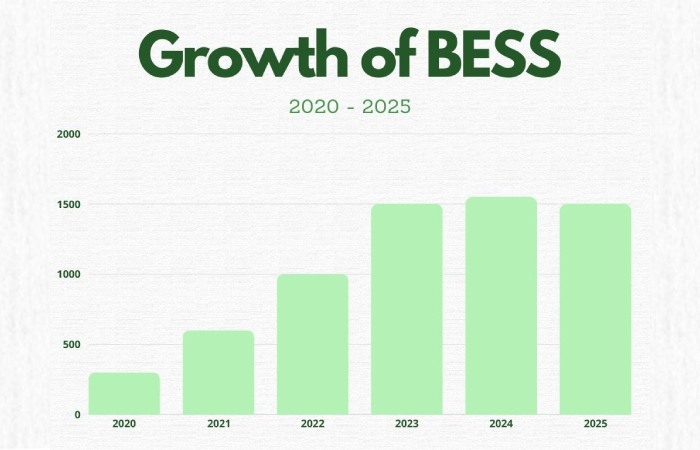
Storage in Moss Landing has also been successful to the extent that it now competes or exceeds the capacity of the rest of the gas turbines.
Environmental Impact
The transformation to battery storage significantly reduced the environmental footprint of the facility.
Emission Reductions
Since peak fossil generation, Moss Landing’s CO2 emissions have dropped by an estimated 70–90% depending on year and grid conditions.
Local Ecosystem Preservation
Being on Monterey Bay, environmental advocates have closely monitored water usage, noise, and local wildlife interactions.
Tech and Innovation at Moss Landing
Moss Landing is not just a power plant — it’s a laboratory for grid innovation.
Advanced Energy Storage Tech
| Technology | Feature |
| Lithium-ion Batteries | High energy density, fast response |
| Power Conversion Systems | Grid frequency support |
| Monitoring & AI | Predictive maintenance & optimized dispatch |
This tech stack enables the plant to provide:
- Frequency regulation
- Spinning/non-spinning reserves
- Arbitrage (charge when cheap, discharge when expensive)
- Black start capability (in select scenarios)
Operational Economics
Understanding the economics helps explain why the plant shifted its core function.
Generation vs Storage Value
| Metric | Gas Generation | Battery Storage |
| Fixed Cost | High | Moderate |
| Variable Cost | Fuel dependent | Near zero fuel |
| Revenue Drivers | Energy sales | Arbitrage, ancillary services, capacity |
| Carbon Cost | High | Low |
Dispatchable Value Over Time
Because storage can respond instantly, it often earns higher per-MW compensation for grid services compared to thermal generation — especially during peak demand periods.
Policy and Regulation Influence
Moss Landing’s evolution was shaped by several policy forces:
- California Energy Policies
- Renewables Portfolio Standard (RPS) targets increasing renewable adoption.
- Clean Energy Mandates demanding zero-carbon resources.
- Air Quality Regulations reducing allowable emissions.
Federal Incentives
ITC (Investment Tax Credits) for energy storage systems (when paired with renewables)
Infrastructure investment incentives
FERC Order 841 enabling storage market participation
Future Potential & Expansion
Storage Expansion Possibilities
Industry and utility planners are evaluating:
Expanding battery duration (4 hr → 8 hr)
Adding hydrogen or flow batteries
Microgrid integration
Integration with Offshore Wind
Moss Landing’s coastal location could position it as a hub for future Eastern Pacific or offshore wind energy landing.
Frequently Asked Questions (FAQs)
Q1: Is the Moss Landing Power Plant still operational?
Yes. While most original gas units have retired, the site continues operations via battery storage and remaining generation capacity.
Q2: Why is Moss Landing important?
It offers grid flexibility, renewable support, and has one of the world’s largest grid-connected BESS facilities.
Q3: What is the revenue earned by battery storage?
Arbitrage of energy, ancillary services, and capacity markets.
Q4: What is the technology in the facility?
The major ones are lithium-ion battery systems, sophisticated inverters and grid optimization software.
Conclusion
The Moss Landing Power Plant is the symptom of a larger-scale change in the energy infrastructure today – to highly flexible, techno-based storage systems and grid support systems. This change is in line with California ambitious clean energy ambitions and will act as a precedent to other coastal and renewable-rich areas.
Moss Landing provides one of the most interesting real-world testimonies in the energy transition whether it is the integration of renewable, energy economics, large-scale battery technology, or grid modernization strategy.