
The field of quantum computing has changed not only into a more of an experimental idea that can be found in research laboratories but also into a technology with practical industrial consequences. Recent advances in quantum computing 2024 show apparent gains in qubit stability, logic circuit fidelity, hardware scalability and cloud accessibility on an enterprise scale.
The technological innovation of the past decades has been driven by classical computers based on transistor-based architecture. However, the traditional computing platforms would not handle the computationally intensive workloads which are exponential (such as molecular simulations, optimization problems, cryptographic modeling, and artificial intelligence training workloads).
The solutions to these issues can be found in quantum computing which are based on the laws of quantum mechanics, that is:
- Superposition
- Entanglement
- Quantum interference
Unlike binary bits used in classical computing systems, quantum machines operate using qubits, which can simultaneously exist in multiple computational states. This allows quantum processors to execute complex calculations across parallel probability distributions rather than sequential processing pathways.
Latest Breakthroughs in Quantum Computing 2024
1. Quantum Error Correction Takes Center Stage
One of the biggest hurdles in quantum computing has long been error rates and qubit instability. In 2024:
- Physics World named quantum error correction as the Physics Breakthrough of the Year, awarded to two major teams — one led by Mikhail Lukin, Dolev Bluvstein & collaborators (Harvard/MIT/QuEra) and another by Hartmut Neven & team (Google Quantum AI) — both demonstrating significant progress toward reliable error-corrected qubits.
- This reflects a shift from purely increasing qubit counts to stabilizing qubits via error correction protocols, a critical step toward practical quantum computing systems.
2. Logical Qubits and Scalable Architectures
Progress isn’t just about raw qubits — it’s about usable, logical qubits:
- Harvard and collaborators built quantum processors with 48 logical qubits, a milestone recognized as one of 2024’s biggest breakthroughs.
- Logical qubits (error-protected virtual qubits built from many physical qubits) are now being demonstrated repeatedly across platforms — an essential step toward fault-tolerant quantum computing.
3. New Quantum Processor Milestones
Leading quantum hardware platforms saw major advancements:
Google’s Willow Chip
- The Willow processor — a 105-qubit superconducting quantum chip by Google Quantum AI — demonstrated “below threshold” error scaling, meaning error rates drop as the system scales.
- It also performed a benchmark calculation in ~5 minutes that classical supercomputers would require ~~10^25 years to match — a significant performance claim.
IBM’s Modular Systems
- IBM continued expanding its quantum hardware roadmap — including modular, scalable systems designed to interconnect processors for larger workloads.
RIKEN/NTT Optical Quantum Computer
- A general-purpose optical quantum computer, operating near room temperature with terahertz-class speeds and cloud access, was launched — expanding beyond superconducting/qubit-based systems.
4. Hybrid and Practical Quantum Applications Emerging
Hardware is now beginning to solve real computational problems:
- Research teams demonstrated practical quantum simulations (e.g., speeding up medical device modeling), showing early signs of quantum advantage — where quantum systems outperform classical methods on specific tasks.
- Hybrid workflows combining quantum processors with classical supercomputers are increasingly common, especially in chemistry, materials science, and optimization research.
5. Broader Industry Progress and Roadmaps
2024 wasn’t just about isolated results — it also produced strategic momentum across the field:
- Major companies (IBM, Google, Microsoft, Quantinuum, IonQ, etc.) published multi-year quantum roadmaps targeting fault-tolerant computing and commercial applications within the next decade.
- Topological qubit research (e.g., Majorana qubit efforts) and hybrid error-reduced systems are becoming focal points for scaling.
Why These Breakthroughs Matter (2024 Quantum Computing)
| Breakthrough Area | What Happened in 2024 | Why It Matters | Long-Term Impact |
| Quantum Error Correction | Recognized as Breakthrough of the Year by Physics World; major demonstrations by Google Quantum AI and QuEra Computing | Proved that quantum systems can reduce errors as they scale | Enables fault-tolerant quantum computers capable of long, reliable computations |
| 48 Logical Qubits Demonstrated | Harvard/MIT/QuEra teams executed complex algorithms on error-corrected logical qubits | Shows quantum machines are moving beyond unstable physical qubits | Brings practical quantum advantage closer for chemistry, optimization, and AI |
| Improved Logical Qubit Reliability | Collaboration between Microsoft and Quantinuum achieved logical qubits with dramatically lower error rates | Demonstrates that quantum information can be stabilized for longer periods | Supports development of scalable enterprise-grade quantum systems |
| Willow Quantum Processor (105 Qubits) | Google introduced the Willow chip with below-threshold error scaling | Confirms scalability improvements in superconducting quantum hardware | Accelerates roadmap toward large-scale universal quantum computers |
| Optical Quantum Computing Advances | Research groups like RIKEN and NTT developed room-temperature optical quantum systems | Expands architecture diversity beyond superconducting/trapped-ion models | Offers potentially more energy-efficient and scalable quantum platforms |
| Specialized Quantum Systems | Companies like D-Wave Systems improved performance for optimization problems | Shows near-term quantum benefit in specific industries | Supports logistics, finance, and manufacturing optimization use cases |
| Clear Industry Roadmaps | Major tech firms published multi-year fault-tolerance roadmaps | Provides confidence to investors and enterprises | Encourages commercial adoption and ecosystem growth |
Understanding the Role of Qubits in Modern Quantum Systems
A classical bit exists in either a 0 or 1 state at any given moment. In contrast, a qubit can exist in a superposition of both states simultaneously.
This enables:
- Parallel computational modeling
- Rapid optimization problem solving
- Enhanced machine learning processes
- High-dimensional simulation capability
However, qubits are extremely sensitive to:
- Thermal fluctuations
- Electromagnetic interference
- Environmental noise
- Decoherence
Until very recently, adding more qubits to a system prompted more error propagation as opposed to better performance. A change in the focus of increased qubit count to improved quantum error correction protocols to increase logical qubit efficiency was one of the biggest in 2024.
Key Quantum Computing Breakthroughs in 2024
The most notable breakthroughs in 2024 were concentrated across the following technological domains:
- Logical qubit construction
- Fault-tolerant system design
- Error correction protocols
- Neutral atom computing platforms
- Hybrid classical-quantum processing models
Quantum Computing: 2024 vs 2025
| Aspect | Quantum Computing 2024 | Quantum Computing 2025 |
| Error Correction Progress | Major progress recognized globally — quantum error correction became a top breakthrough of the year, and labs demonstrated increasing stability in logical qubits. | Continued dramatic advancement — error correction and fault-tolerant methods pushed further, enabling longer, more reliable quantum computations. (spinquanta.com) |
| Qubit Scaling & Hardware | Focus largely on improving quality over quantity; systems like the 105-qubit Google Quantum AI Willow processor showcased below-threshold error scaling. | Hardware scaled further with announcements of 1000+ qubit machines, advanced multi-chip systems, and enhanced architectures designed for real workloads. ( |
| Logical Qubit Usage | Proof-of-concept demonstrations of dozens of logical qubits highlighted error-protected operation. | Logical qubits become more usable for longer programs and practical error-suppression strategies were integrated into software stacks. |
| Practical Applications | Still mostly experimental, with research and simulation tasks dominating. | Early practical applications began to emerge, such as quantum simulations exceeding classical performance in niche areas (e.g., medical device models). |
| Commercial & Investment Momentum | Investment growth in quantum startups accelerated and national strategies expanded. | Capital influx continued escalating, with more strategic partnerships, hybrid cloud models, and industry collaborations shaping the future. |
| Software & Algorithms | Algorithm research focused on error-suppression and hybrid workflows. | New algorithm categories emerged for finance, chemistry, and optimization — and hybrid quantum-classical co-design became prevalent. |
| Market Trends | Market expectations shifted toward credible fault-tolerant roadmaps, validating commercial potentials. | Market projections expanded further — quantum tech startups saw booming funding, and national programs matured. |
| Industry Milestones | Recognition of quantum error correction and scalable qubit design as turning points. ( | Momentum toward practical quantum advantage gained pace, with demonstrable industry use cases entering pilot stages. |
| Strategic Roadmaps | Roadmaps focused on achieving fault tolerance and scaling progressively. | Roadmaps expanded aggressively, projecting large-scale quantum systems and hybrid architectures. |
Quantum Computing Costs: 2024 vs 2025 (Country/Region Perspective)
| Country / Region | 2024 Cost Trends | 2025 Cost Trends / Change | Notes/Drivers |
| United States | • Cloud QaaS pricing typical: entry via pay-per-shot or minor subscriptions (e.g., ~$0.30–$1.60 per quantum task on AWS/QaaS). • Enterprise plans from major providers often $10k–$50k+ monthly. | • Overall cloud costs trending down 10–20% vs 2024 for equivalent workloads. • More enterprise subscription tiers added (structured pricing for specific use cases). (makbtech.com) | Strongest ecosystem with many provider options (IBM, AWS, Azure). Market competition is driving modest pricing reductions for cloud access. |
| Europe | • Access via AWS, Microsoft Azure, and local hubs (e.g., Pasqal via OVHcloud) with similar per-shot pricing (~$0.0009–$0.03) but occasional regional premiums. | • Regional providers (e.g., Pasqal) expand availability, keeping prices competitive with global peers. • Enterprise subscriptions remain high (~€€ pricing similar to USD). ( | Cloud service pricing aligns with global standards, but data-residency/latency may slightly increase effective cost. |
| United Kingdom | • Similar service access via AWS/Azure (per-shot and subscription models). • National investment supports subsidized research access. | • Continued investment direction keeps cloud costs relatively stable; enterprise levels similar to EU/US. • Research institutions may get more subsidized internal access. | UK producers benefit from national funding strategies. |
| China | • Less public cloud pricing transparency; domestic access often subsidized by government research programs. | • Continued heavy national investment suggests internal access costs remain structured under research budgets, not typical commercial rates. | Hardware costs likely absorbed by government/strategic partnerships; not typical pay-per-use model. |
| India | • Users currently rely on international QaaS providers, paying roughly ~₹3,000/min (~$45/min) for cloud quantum access. | • With new quantum facilities rolling out (e.g., Amaravati hub), local pricing may become lower for research/enterprise access over time. | India’s model today resembles use-case rental; domestic cloud pricing likely to follow once local systems are operational. |
| Japan | • Primarily research access; some cloud models via major global providers. | • Domestic launch of a homegrown quantum computer may allow local institutions cheaper research access/negotiated contracts vs 2024. | Domestic availability could reduce reliance on foreign cloud pricing for some use cases. |
Logical Qubits vs Physical Qubits
Logical qubits are composed of multiple physical qubits designed to maintain computational stability against environmental noise.
| Qubit Category | Noise Resistance | Error Correction Capability | Practical Application Readiness |
| Physical Qubits | Low | Minimal | Experimental |
| Logical Qubits | Medium | Significant | Emerging |
| Topological Qubits | High | Advanced | Development Stage |
Redundant qubit innovation The amount of physical qubits needed to run big quantum algorithms goes down because logical qubits, which are more dependable and cost-effective, implement it.
Quantum Hardware Platform Comparison (2024)
Different hardware architectures offer unique trade-offs in performance, stability, and scalability.
| Hardware Platform | Qubit Technology | Coherence Time | Error Rate | Scalability |
| Superconducting Circuits | Josephson Junctions | Low | Medium | High |
| Trapped Ion Systems | Electromagnetic Traps | High | Low | Medium |
| Photonic Systems | Optical Circuits | Medium | Low | High |
| Neutral Atom Platforms | Laser Trapping | High | Low | Very High |
| Topological Qubits | Majorana Particles | Very High | Minimal | Experimental |
Neutral atom quantum computing gained momentum in 2024 due to:
- Parallel qubit manipulation
- Improved coherence time
- Reduced system noise
- Modular scalability
These systems are expected to support larger computational frameworks by 2026.
Quantum Computing Cloud Pricing Comparison
Access to quantum hardware remains predominantly cloud-based due to infrastructure costs associated with:
- Cryogenic cooling
- Electromagnetic shielding
- Quantum processor fabrication
- Error correction circuitry
Annual Quantum Cloud Access Pricing (2024)
| Quantum Service Provider | Entry-Level Cost | Enterprise Cost | Deployment Model |
| IBM Quantum Cloud | $96,000 | $1,000,000+ | Cloud |
| Microsoft Azure Quantum | $10,000 | $500,000 | Hybrid |
| Amazon Braket | $8,000 | $350,000 | Cloud |
| Rigetti Quantum Services | $12,000 | $400,000 | Cloud |
| Neutral Atom Platforms | $150,000 | $2,000,000+ | On-Premise |
Cloud-based access provides the most economically viable entry point for enterprises experimenting with quantum algorithms.
Cost of Building a Private Quantum Computing Infrastructure
Deploying an on-premise quantum computing system involves substantial capital investment.
| Infrastructure Component | Estimated Cost Range |
| Cryogenic Cooling System | $500,000 – $2M |
| Magnetic Shielding | $200,000 – $1M |
| Quantum Processor | $1M – $10M |
| Control Electronics | $250,000 – $900,000 |
| Software Integration | $100,000 – $500,000 |
| Annual Maintenance | $100,000 – $500,000 |
For most enterprises in 2024, cloud-based quantum platforms remain the preferred deployment model.
Global Quantum Computing Investment Distribution (2024)
Sector-Wise Investment Share
| Sector | Investment Share (%) |
| Government | 42% |
| Technology Companies | 31% |
| Startups | 17% |
| Academic Institutions | 10% |
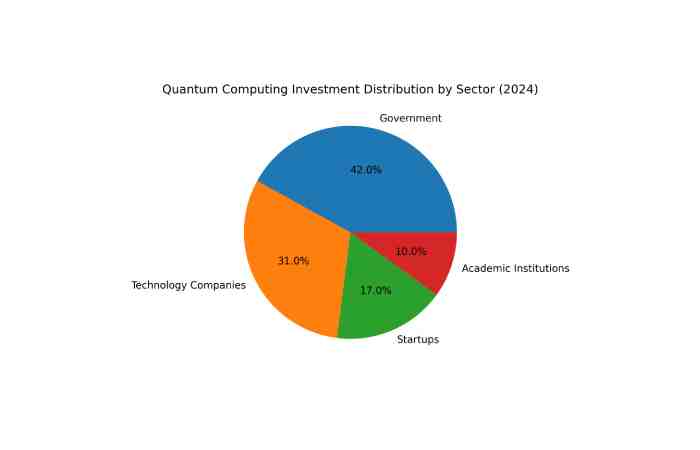
Public sector investment remains dominant due to national security and encryption-related research priorities.
Quantum Computing vs Classical Supercomputers
| Metric | Classical HPC | Quantum Computing |
| Processing Unit | Bit | Qubit |
| Parallel Processing | Limited | Massive |
| Energy Consumption | High | Low |
| Optimization Problems | Time Intensive | Rapid |
| Molecular Simulation | Years | Hours |
| Encryption Analysis | Impractical | Feasible |
| AI Training Efficiency | Moderate | Potentially High |
Quantum computing demonstrates clear advantages in solving NP-hard optimization challenges across:
- Logistics networks
- Pharmaceutical research
- Climate modeling
- Financial risk analysis
- Materials engineering
Enterprise Applications Emerging in 2024
Financial Services
- Portfolio optimization
- Risk simulation
- Fraud detection modeling
- High-frequency trading analysis
Healthcare & Pharmaceuticals
- Drug discovery
- Molecular interaction modeling
- Genetic sequencing optimization
- Vaccine development
Artificial Intelligence
- Quantum neural networks
- Data clustering optimization
- Machine learning acceleration
Transportation & Logistics
- Route optimization
- Traffic simulation
- Supply chain management
Patent Filing Distribution in Quantum Technology (2024)
| Country | Patent Share (%) |
| China | 38% |
| United States | 29% |
| Japan | 12% |
| Germany | 9% |
| South Korea | 7% |
| Others | 5% |
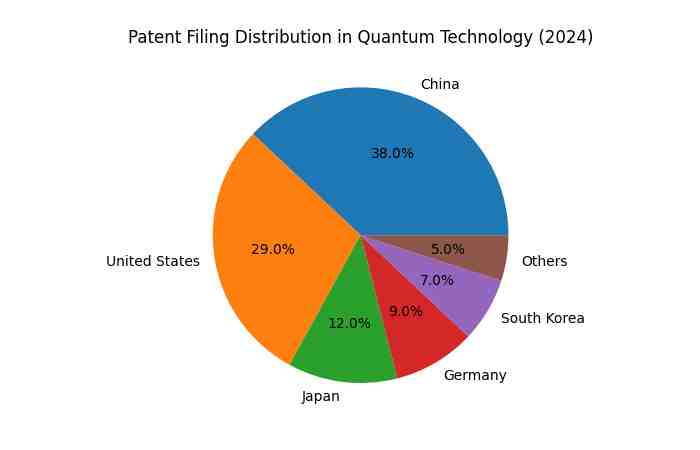
Geopolitical competition in quantum innovation has intensified significantly.
Ongoing Challenges in Quantum Adoption
Despite the latest breakthroughs in quantum computing 2024, several limitations remain:
- Qubit decoherence
- Hardware fragility
- Cooling infrastructure requirements
- Algorithm complexity
- Software ecosystem immaturity
The obstacles persist in slowing mainstream adoption of the enterprise.
Future Market Outlook (2025–2035)
Industry forecasts suggest:
- Quantum computational advantage by 2026
- Fault-tolerant systems by 2029
- Hybrid quantum-AI computing by 2030
The market revenue of global quantum computing will increase by:
- $4 Billion in 2024
- To $72 Billion by 2035
Driven by applications in:
- Financial modeling
- Pharmaceutical simulation
- Advanced manufacturing
- Artificial intelligence
Final Analysis
The latest breakthroughs in quantum computing 2024 represent a structural shift toward scalable and commercially viable quantum architectures. Advances in logical qubit construction, improved quantum error correction protocols, and neutral atom computing platforms have enhanced computational stability and reduced hardware inefficiencies.
Though the large-scale implementation is still limited by infrastructure and the complexity of the algorithm, hybrid quantum-classical systems may be integrated into enterprise cloud computing infrastructure in the next ten years.
Early investment in quantum-ready infrastructure and algorithm development may provide long-term competitive advantages in solving computationally intensive problems across multiple industries.